
Introduction
Medical emergencies can put significant financial pressure on families. A single hospitalization can cost lakhs of rupees, making health insurance an essential part of financial planning.
Choosing the best health insurance plan for your family is not just about finding the lowest premium. You need adequate coverage, access to quality hospitals, claim support, and protection against rising healthcare costs.
In this guide, you’ll learn how family health insurance works, the features to compare, recommended coverage amounts, common mistakes to avoid, and how to choose the right plan for your family in 2026.
Affiliate Disclosure:
Some links may be affiliate links. We may earn a commission at no extra cost to you.
Table of Contents
- Why Families Need Health Insurance
- Types of Family Health Insurance Plans
- Features to Compare
- Recommended Coverage by Family Size
- How to Choose the Best Family Plan
- Real-Life Examples
- Common Mistakes to Avoid
- FAQ
Why Families Need Health Insurance
Healthcare costs continue to rise every year.
A family health insurance plan helps:
✔ Cover hospitalization expenses
✔ Protect savings
✔ Access cashless treatment
✔ Reduce financial stress
✔ Provide long-term healthcare security
Example
A family of four facing a ₹10 lakh hospitalization bill can avoid a significant financial burden with adequate health insurance coverage.

Types of Family Health Insurance Plans
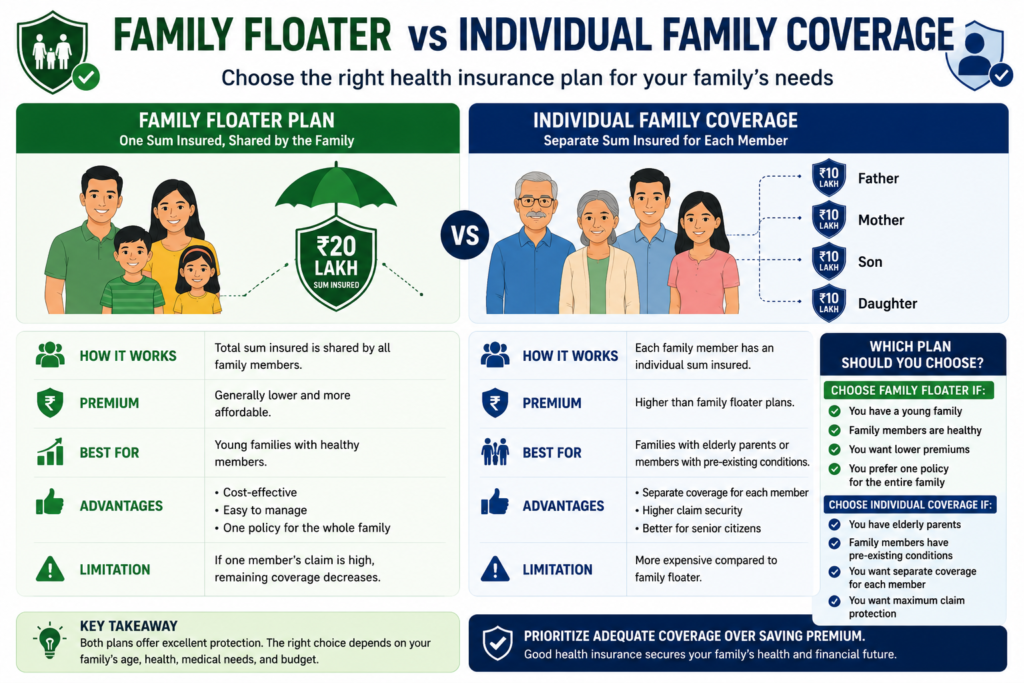
Family Floater Plan
One shared sum insured for all family members.
Best For:
- Young families
- Couples with children
Advantages
✔ Lower premium
✔ Easy policy management
Individual Family Coverage
Separate policies for each member.
Best For:
- Families with elderly parents
- Members with pre-existing conditions
Advantages
✔ Dedicated coverage
✔ Better for high-risk individuals
Key Features to Compare
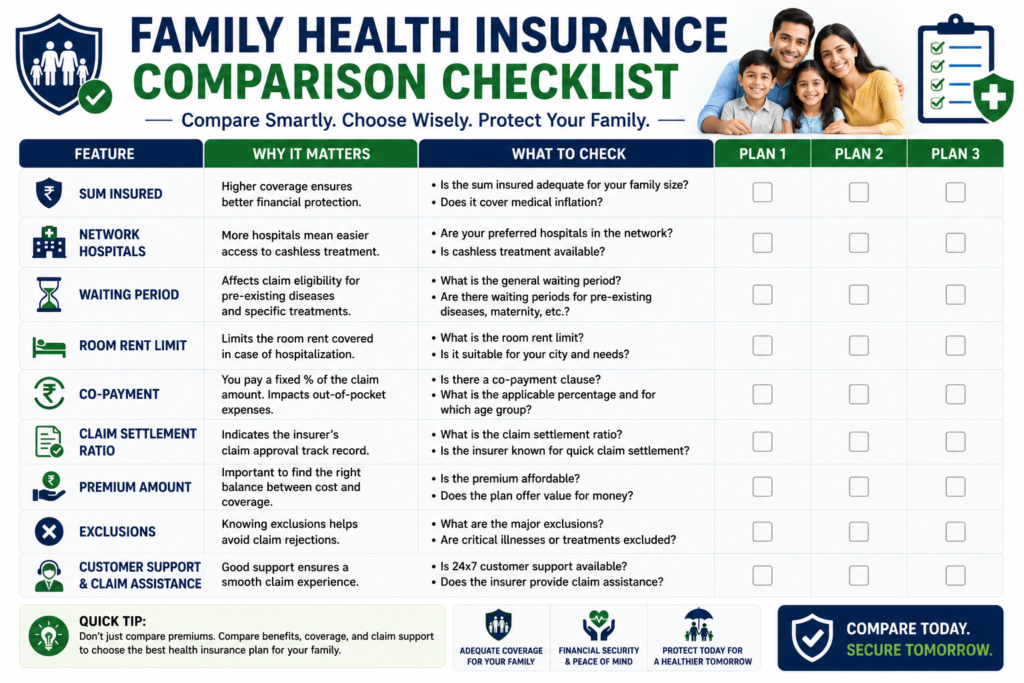
Before selecting a family health insurance plan, compare:
| Feature | Why It Matters |
|---|---|
| Sum Insured | Determines coverage amount |
| Network Hospitals | Supports cashless treatment |
| Waiting Period | Impacts claim eligibility |
| Room Rent Limit | Affects claim payout |
| Co-Payment | Impacts out-of-pocket expenses |
| Claim Support | Improves claim experience |
Recommended Coverage by Family Size
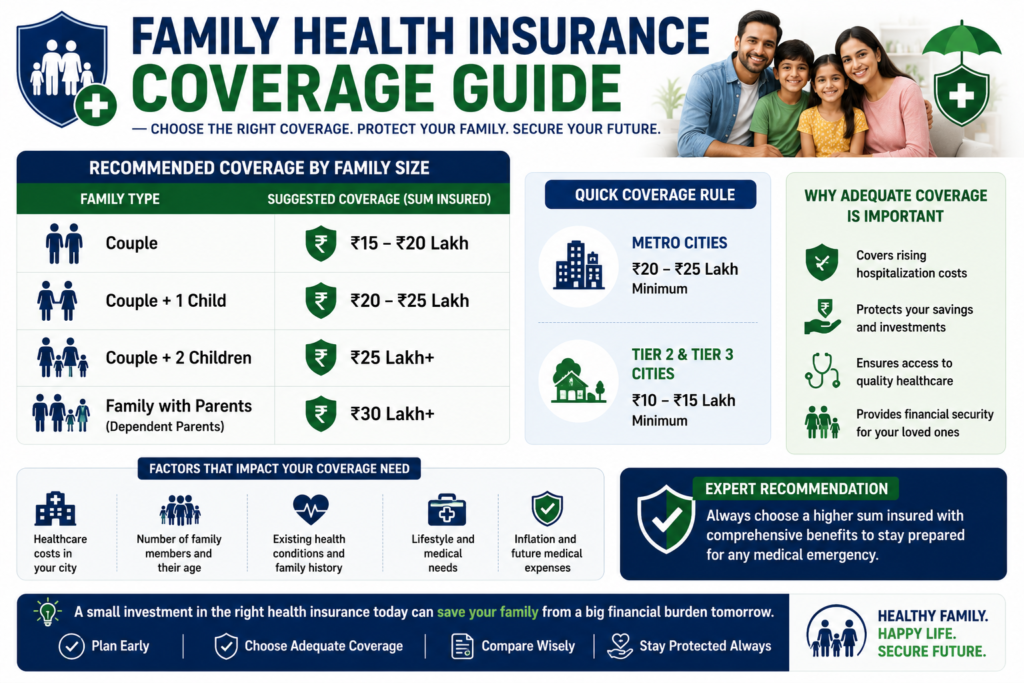
| Family Type | Suggested Coverage |
| Couple | ₹15–20 lakh |
| Couple + 1 Child | ₹20–25 lakh |
| Couple + 2 Children | ₹25 lakh+ |
| Family with Parents | ₹30 lakh+ |
Quick Coverage Rule
Metro Cities:
₹20–25 lakh minimum
Tier 2 & Tier 3 Cities:
₹10–15 lakh minimum
How to Choose the Best Family Health Insurance Plan
Step 1
Assess family healthcare needs.
Step 2
Estimate required coverage.
Step 3
Compare plan benefits.
Step 4
Check hospital network.
Step 5
Review claim support.
Step 6
Compare premiums and value.
Real-Life Examples
Example 1
Rahul and Priya
Age:
32 and 30
Child:
1
Recommended:
Family Floater ₹20 lakh
Reason:
Young healthy family.
Example 2
Amit and Sunita
Age:
58 and 55
Recommended:
Separate Individual Plans
Reason:
Higher claim probability.
Example 3
Family with Two Children
Recommended:
Family Floater ₹25 lakh+
Reason:
Cost-effective and adequate coverage.
Compare Family Health Insurance Plans
Before buying a plan:
✔ Compare coverage
✔ Compare premiums
✔ Compare benefits
✔ Compare claim support
👉 Compare family health insurance plans through Policybazaar.
(Link)
Common Mistakes to Avoid
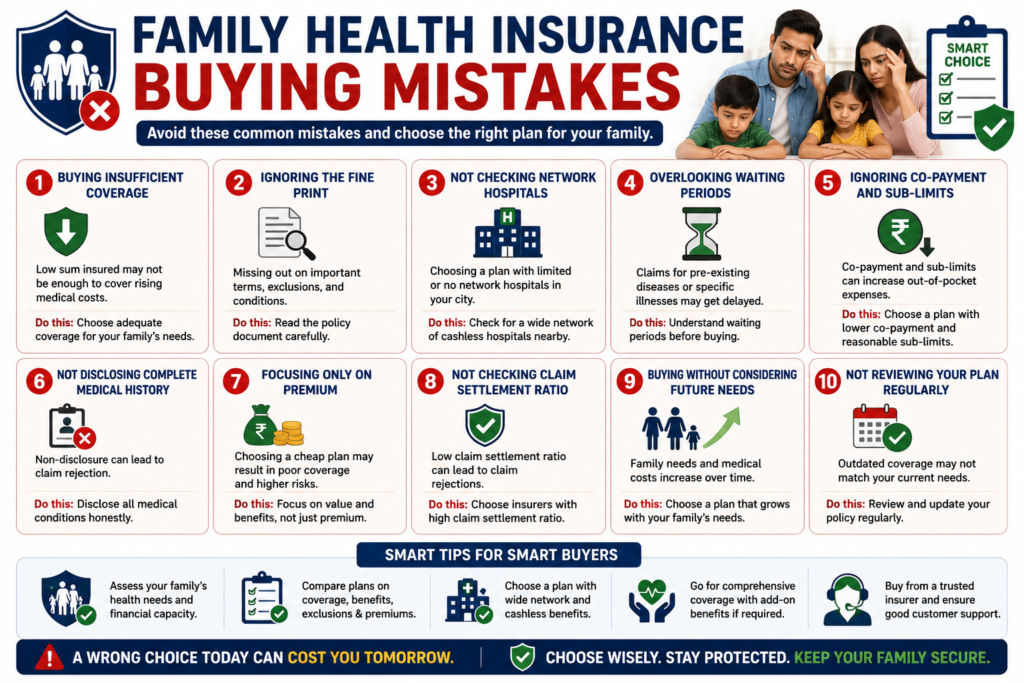
Choosing the Cheapest Plan
Coverage matters more than premium alone.
Ignoring Medical Inflation
Healthcare costs continue to rise.
Choosing Low Coverage
Underinsurance can create financial stress.
Ignoring Waiting Periods
Review policy terms carefully.
Not Checking Network Hospitals
Cashless access is important.
Safe Health Insurance Buying Tips
✔ Buy early
✔ Choose adequate coverage
✔ Review exclusions
✔ Compare multiple plans
✔ Consider super top-up plans
Our Recommendation
Young Families
Family Floater ₹20–25 lakh
Families with Parents
Separate Coverage
Metro City Families
₹25 lakh+ Coverage
High-Income Families
₹50 lakh+ Protection Including Top-Up Plans
External Reference
For insurance regulations and consumer awareness information, refer to IRDAI.
Our Experience
At Nivesh Saathi, we regularly evaluate health insurance plans, healthcare costs, policy features, and claim support factors to help readers choose suitable family health insurance coverage.
Conclusion
The best family health insurance plan is one that balances affordability, adequate coverage, hospital access, and long-term financial protection.
Choose a plan that protects your family’s health without compromising your financial goals.
Compare Plans Now
Compare premiums, features, and coverage options through Policybazaar.
(Link)
Related Articles
- How Much Health Insurance Cover Do You Need in India? (2026 Guide)
- Family Floater vs Individual Health Insurance: Which Is Better in 2026?
FAQ
Which health insurance is best for families in India?
The best plan depends on family size, age, healthcare needs, and coverage requirements.
Is family floater health insurance better?
For many young families, Family Floater plans provide cost-effective protection.
How much health insurance cover should a family of four have?
Many experts recommend ₹20–25 lakh or higher depending on city and healthcare costs.
Can parents be included in family health insurance?
Yes, but separate coverage may be more suitable for older parents.
What is the ideal family health insurance coverage?
For many urban families, ₹20–25 lakh is considered a reasonable starting point.
Is employer health insurance enough?
Employer coverage may not always provide sufficient protection.
Should I buy a super top-up plan?
A super top-up plan can increase coverage at a relatively lower premium.
How do I compare family health insurance plans?
Compare coverage, waiting periods, network hospitals, claim support, exclusions, and premiums.
About the Author
Shashikant Pawar is the founder of Nivesh Saathi and writes practical guides on insurance, loans, investments, and personal finance for Indian readers.
About Nivesh Saathi
Nivesh Saathi helps Indians make smarter financial decisions through trustworthy, easy-to-understand financial education and product comparisons.
Disclaimer
This article is for educational purposes only and should not be considered insurance advice. Please review policy documents carefully before purchasing insurance.